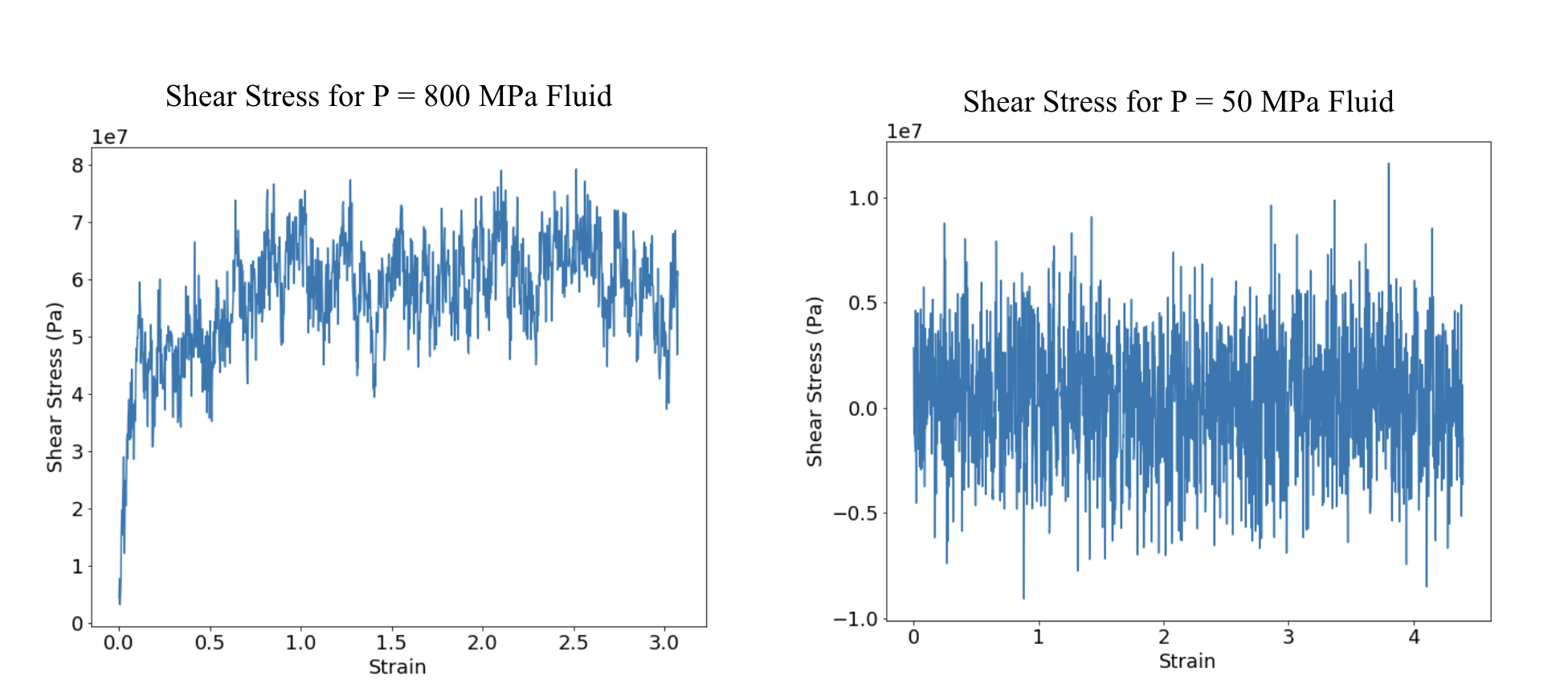
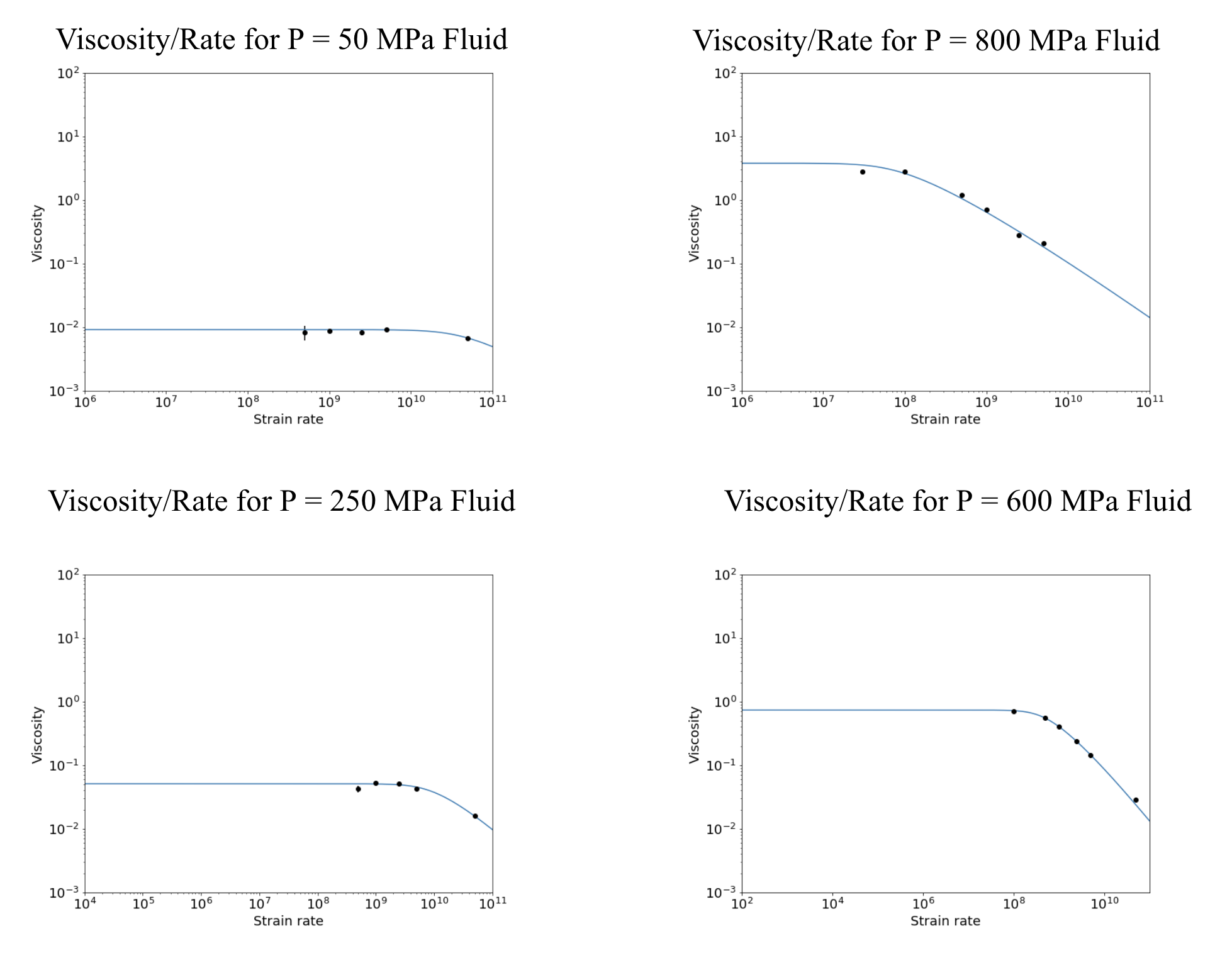
High school research internship through the USAEOP REAP program at Johns Hopkins University and HEMI. Under the guidance of Dr. Mark Robbins and Marco Galvani, I used molecular dynamics simulations to investigate how fluid viscosity changes with temperature and pressure.
The project focused on the viscous behavior of 2,2,4-trimethylhexane, a model fluid relevant to the study of lubricants and high-pressure fluid behavior. Simulations were used to explore how microscopic molecular interactions produce measurable macroscopic properties such as viscosity.
Technologies
- ProgrammingC++, Python (Matplotlib, NumPy)
- SimulationLAMMPS, AIREBO-M
- ComputingLinux, SLURM, MARCC HPC cluster, Jupyter Notebook
Research Background
A fluid's macroscopic behaviour is determined by interactions between its constituent molecules. Molecular dynamics provides a way to study this relationship by numerically simulating the motion of individual atoms and molecules using classical mechanics.
One behaviour of interest was shear thinning, in which a fluid's apparent viscosity decreases under deformation. Understanding how viscosity responds to environmental conditions such as pressure and temperature is important for applications involving lubricants, where fluid properties influence heat dissipation and material performance.
Molecular Dynamics Simulation
The simulations modeled the motion and interactions of atoms within the fluid. Molecular dynamics uses Newtonian mechanics to update particle positions and velocities over time, while quantities such as temperature and pressure emerge from the collective behaviour of the simulated system.
I used LAMMPS, an established and highly optimised molecular dynamics package. This allowed the research to focus on simulation parameters, interaction models, and analysis of the resulting data.
The simulations used the AIREBO-M potential to model interactions between atoms in the 2,2,4-trimethylhexane system. AIREBO-M is an extension of the AIREBO family of interatomic potentials designed for applications involving high-pressure conditions.
The interaction model determines how forces between atoms are calculated, which in turn affects the simulated motion of the molecules and the macroscopic properties measured from the system.
Molecular dynamics simulations can require a lot of computationation. To deal with this, jobs were submitted to the MARCC high-performance computing cluster using Linux and the SLURM workload manager.
Technical milestones and results were summarised in a formal presentation at the conclusion of the internship, providing an opportunity to communicate the project's methodology, results, learnings outcomes, and challenges to a broader audience.